Sidonia Tameshtit – 2026 Studentship Recipient
Undergraduate, Applied Mathematics and Mechanical Engineering Student, Queen’s University
Generously funded in memory of Anand Acharya, along with additional donors of Brain Tumour Foundation of Canada
Supervisor: Dr. Xian Wang
Project title: “Improving Drug Retention in Glioblastoma Using Magnetically Guided Bio-Hybrid Delivery”
Description of the project:
Treating glioblastoma is especially challenging because many cancer drugs cannot be delivered to the tumour in a targeted and effective way. Even when nanoparticles are used to carry drugs, only a very small amount typically reaches the tumour, limiting treatment effectiveness and increasing side effects.
This project explores a new biohybrid drug-delivery approach that combines magnetic nanoparticles with macrophages, a type of immune cell that naturally travels toward tumour tissue. By loading drugs onto magnetic nanoparticles and placing them inside macrophages, this research aims to guide drug-carrying cells to the tumour using external magnetic fields and keep the drugs localized where they are most needed.
The project will study how to safely create these drug-carrying cells and test whether this approach improves the duration of drug exposure near tumour cells compared with current delivery methods. If successful, this research could lay the groundwork for more precise and effective treatments for glioblastoma, potentially improving outcomes and reducing harm to healthy brain tissue.
Impact of receiving the award:
When I was diagnosed with a brain tumour at 20 years old, I couldn’t fathom how life would ever feel normal again. It took time to realize that while I would never return to the person I was before, maybe that wasn’t such a bad thing. I gained a new perspective, a deeper gratitude for the people I love, and a clear sense of purpose.
After my tumour was resected, all I could think of was how incredibly fortunate I had been. Despite the physical and emotional challenges I faced, I understood that while I had treatment options, so many others diagnosed with brain tumours are not afforded the same outcome. This stark reality is what drives me. Brain Tumour Foundation of Canada’s Studentship provides the opportunity to combine my engineering education and personal experience into research that I hope will one day improve outcomes for others impacted by a brain tumour.
I am deeply grateful to Brain Tumour Foundation of Canada and to the donors whose generosity makes this work possible. Their support does more than fund research; it gives survivors like me the chance to turn hardship into purpose and offers hope to those still fighting.
Midpoint Report – September 2026
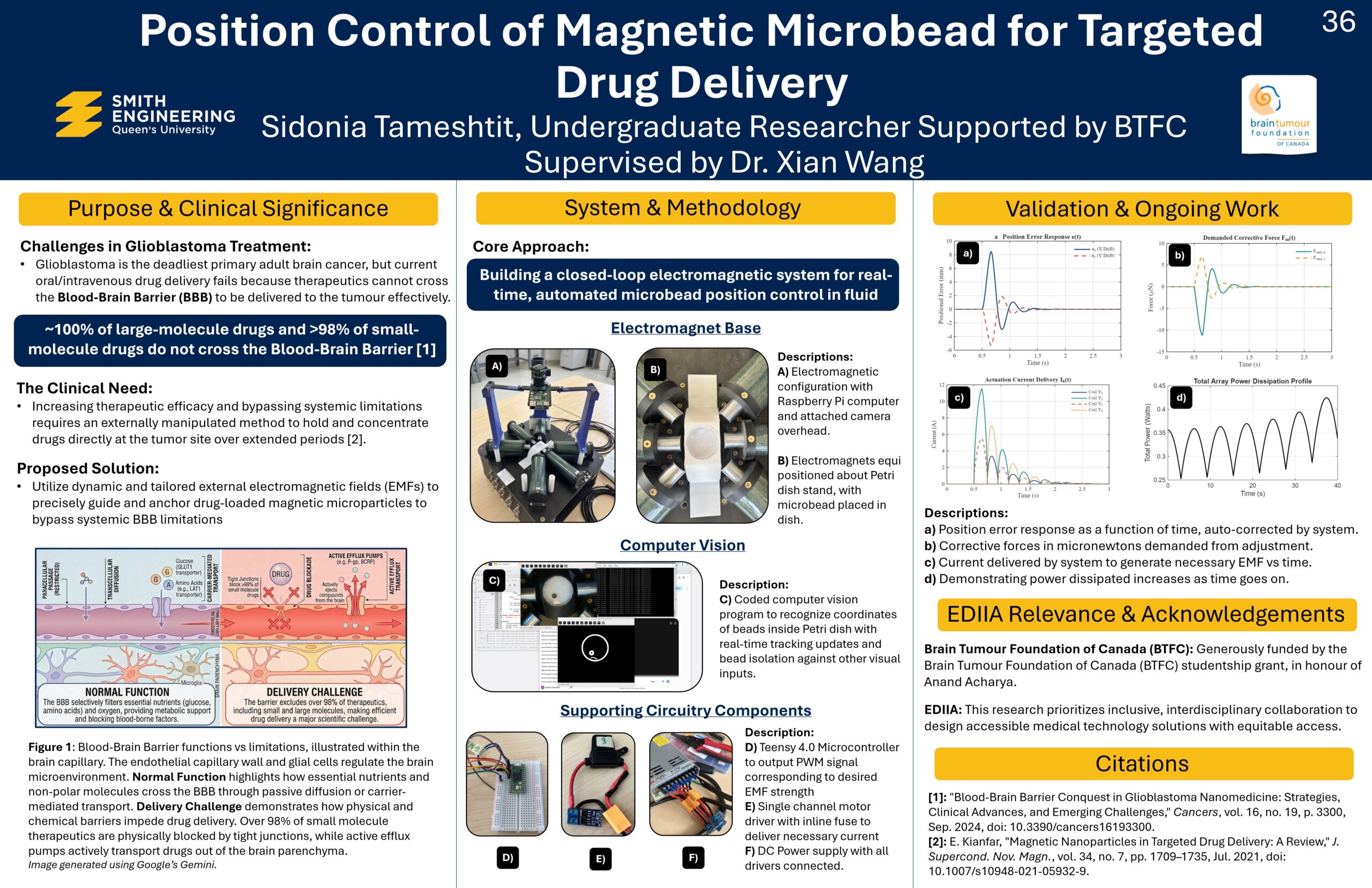 Glioblastoma is one of the most aggressive and difficult-to-treat brain cancers, largely because the blood-brain barrier (BBB) and rapid fluid circulation stop over 98% of chemotherapeutic drugs from concentrating at the tumour site. To address this challenge, this research investigates creating a magnetic bio-hybrid delivery system to control the position of magnetic microbeads linked to macrophages. This system uses external electromagnetic fields to guide drug-loaded particles to targeted locations. By validating dynamic control over these particles, the goal is to eventually steer them across or beyond the blood-brain barrier to the tumour site, localizing therapeutics for maximum treatment effectiveness and enhanced drug absorption.
During the first half of this project, I built and validated an automated, closed-loop electromagnetic control platform. Combining computer vision camera tracking, custom driver electronics, and electromagnetic coils, the system detects particle motion in real time and dynamically adjusts magnetic forces to steer particles along precise paths or hold them steady against fluid flow. This hardware and software foundation demonstrates that magnetic guidance can reliably overcome fluid resistance, setting the stage for upcoming co-culturing and drug-retention tests with therapeutic bio-hybrids.