A life-changing mistake and the miracle that followed
Dave Cowan thinks he might just be the luckiest man alive.
Having lived with bipolar disorder for more than 30 years, he’d been prescribed lithium to manage it. When he was later prescribed blood pressure medication in December 2024, he began to have an adverse reaction caused by an interaction between the two medications.
“All the tremors, all the shaking,” Dave says. “I was diagnosed with Parkinson’s.”
While managing those symptoms too, Dave took part in a program at the Centre for Addiction and Mental Health (CAMH) in Toronto that looked at the long-term effects of lithium in the body.
“That’s when the doctor said, ‘There’s no way he has Parkinson’s,’ Dave recalls. ‘He’s got lithium poisoning.’”
The wrong patient at the right time 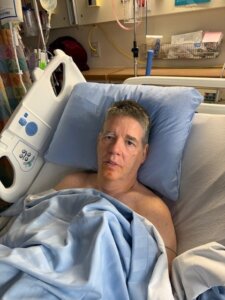
He’d already been to the hospital with his symptoms, saying he “almost died three times.”
At his latest hospital visit for what turned out to be lithium poisoning, he was mistakenly brought in for a CT scan.
“It wasn’t meant for me,” he says. “It was meant for someone else in the hospital. So, this doctor came into my room and said, ‘You’re not my patient,’ and I said, ‘You’re not my doctor.’”
The doctor shared that the CT scan Dave wasn’t supposed to have revealed a brain tumour. An MRI followed—this time, with Dave’s name on the requisition—confirming he had a pituitary adenoma.
He’d lost about half his vision at this point, which had previously been attributed to his lithium poisoning.
Dave connected with a neurosurgeon at University Hospital in London, Ont., where he also saw specialists such as an endocrinologist and an ear, nose and throat doctor. His surgery was scheduled for November 19, 2025, with hopes to remove his tumour and restore his vision.
A memorable moment 
When he was brought in to the operating room that day, Dave looked at the 30 medical students surrounding him in the operating room and thought how they could be future neurosurgeons helping someone like him.
“Because of who I am and what I believe in, I engaged all 30 students and had them tell me their names,” Dave says. “The anesthesiologist said to me, ‘I’ve never had anybody going in for brain surgery have fun lying on the table.’ I was glad to make them laugh, and I mean, who would do that? But who wouldn’t do that? Why wouldn’t I want to make people’s lives more joyful?”
The majority of Dave’s tumour was removed, with the exception of a portion covering the optic nerve and a major artery. He recognizes he may eventually need another surgery, but says he’s glad to know what to expect, and that he trusts in those who helped him.
“It gave me a whole new perspective as to what people go through and what these doctors are capable of,” Dave says. “It just blew me away. I’ve never been so humbled by anything as I have been humbled by this.”
Leaning on his “tribe”
Throughout his medical ordeal, from the lithium poisoning to his brain surgery, Dave’s family and friends stepped in to help.
“My sister and brother-in-law were at my house every single day for a year,” Dave says. “They did everything from cutting my lawn to snow blowing to making food. They were absolutely instrumental in me getting through all of this.”
Dave calls his support system his “tribe,” and mentions how important it is for people to reach out when they’re in need.
“I’ve had all these people helping me through it all,” Dave says. “I’ve had mental health challenges, and I realize that people suffering from mental health issues are quite often alone. Being alone is not a great way to live our lives. We need that tribe.”
Finding gratitude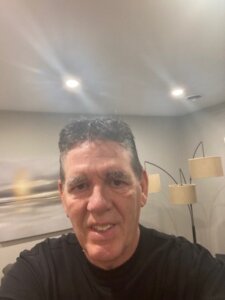
He says helping others, in turn, is what most fulfills him. He wants to help others find and practice gratitude, while making it a part of his own daily life.
He journals each morning, listing 10 things he’s grateful for. At night, he holds a rock he keeps beside his bed and thinks of the good that happened in his day.
“I start my day in a positive way and I end my day in a positive way. We get to make choices in life and those choices can either be negative or positive. If I choose positivity, then I know I’m on the right side of the equation. And how can that not help me get better? How can that not help other people?”
Dave is working to regain his strength and his energy, saying he used to walk five kilometres a day and now struggles to make it around the block. Still, he’s thankful that he’s able to take those small steps forward. He’s also thankful that his vision has mostly returned, when he was so close to losing it completely.
“I wouldn’t have had eyesight by now,” he says, had he not had surgery when he did. “I think, ‘How tough would it be to lose my eyesight?’ But then, I think how grateful I am that it was just my eyesight. I might be the most grateful individual you’ll come across. The fact is, I’m pretty happy.”
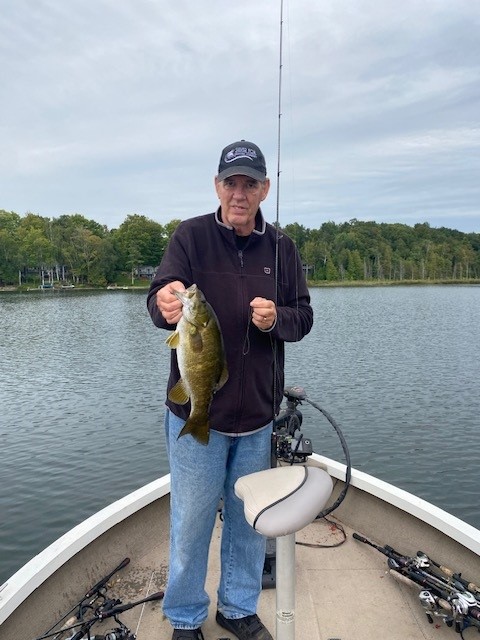
He’s back to work at the golf marketing company he runs, while enjoying time at his camp-turned-second home on the West Arm of Lake Nipissing, Ont., and spending time with loved ones. He’s also committed to helping others and continuing to look on the bright side of life.
“If there’s one way we can help others, it’s by making sure we open up our tribes to include those who need somebody in their corner,” Dave says. “My life’s ambition is to help as many people as possible. No one should be alone, ever. And that’s how I live my life.”