A life well loved
John met Tali in December 1993, when he owned a lawn care business and she worked at an Orangeville, Ont. radio station. John would advertise his business on the radio station and Tali would write the scripts.
Or, she was supposed to.
“He would always show up with his own scripts, so I didn’t like him,” she says, jokingly.
 After weeks of John finding excuse after excuse to call her, he made an official move.
“He sent me a fruit basket,” Tali laughs. “He would say it was supposed to be chocolate.”
As she’d been wrapping up at work to visit her parents in her hometown of Sarnia, Ont., for the holidays, Tali was caught off guard.
“I’d already packed my little old Chevette, and I was like, ‘Where am I supposed to put this?’”
They had their first date in January 1994 and were engaged by June of that year. They bought their first home together 45 minutes outside of Orangeville, got married, and welcomed two daughters, Taija and McKenna. By all accounts, their life was the kind movies are made of. A romantic comedy, at least.
“We were opposites,” she says. “He did have some zingers, but I’m more sarcastic and try to tell a story with a funny twist to it. We made a good match.”
An unexpected turn
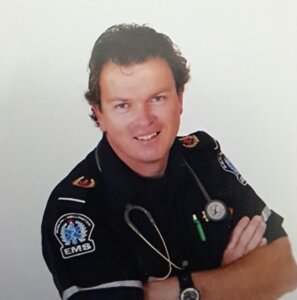 Tali was caught off guard when one day, John confessed he’d like to go back to school to become a paramedic. She was all for him chasing his dream, giving her full support as John pursued his new career. He still ran his lawn care company on the side, alongside his family.
Fifteen years later, John was still working as a paramedic and Tali was starting a new career as a booking clerk at a hospital, when John had to respond to a traumatic call that stuck with him.
“He turned to me and said, ‘I don’t think I can go back to work,’” she says. “I just looked at him and said, ‘I’ve been waiting for you to say that, honey. And that’s okay.’”
John was diagnosed with PTSD shortly after, managing his day-to-day with therapy and the support of his family.
“He didn’t not want to be a paramedic,” she says. “He really struggled with that.”
Over time, John’s behaviour continued to change.
Changes that were easy to misread
John became quieter. He struggled to make small, everyday decisions. He appeared withdrawn. There were moments of forgetfulness and confusion that seemed to improve and return. He experienced headaches and fatigue and often said he simply didn’t feel like himself.
 Because PTSD was already part of his medical history, these changes were understood through that lens. Emotional distance was assumed to be psychological. Difficulty concentrating was attributed to stress. Shifts in mood were seen as part of trauma recovery.
Tali worried about John, but she believed they were facing another difficult period related to PTSD. They were also caretaking for elderly family members and adjusting as their daughters grew into their own lives.
“I came home one day and John said, ‘We have to sell the house,’” Tali recalls. They’d moved a few times over the years, but they’d finally settled into a place they both loved, or so she thought.
Still, she agreed, and they found a small home in a retirement community in Sarnia, Ont.
It was when they were moving that John suddenly snapped at her.
“He had this face I hadn’t seen in the 29 years I’d known him,” she says.
Feeling tension
The next few weeks were even more challenging, as they settled into their new place and prepped for a trip they were both supposed to take.
Just days before they were set to leave, John wasn’t feeling right and wanted to go to the emergency department. Tali didn’t want to go with him.
“He wasn’t the John I knew,” she says. “I dropped him off and went home.”
Eventually, she texted John and asked if he’d like her to join him.
“‘That would be lovely,’” Tali recalls his response. “And that broke my heart.”
She found him wandering in the atrium, far from the emergency department. He’d been given sleeping pills, which he took for two days before deciding they made him feel even worse.
The trip
J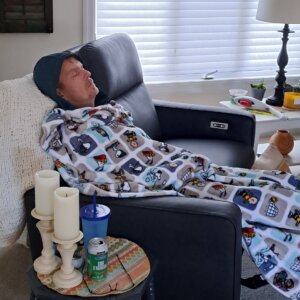 ohn chose not to go on their scheduled trip, and so Tali, their daughter, and their young grandson went instead.
When Tali returned home, the fridge was empty. Basic supplies were out. Tensions were high, but Tali kept deferring to the advice she’d been given in a retreat for spouses of PTSD survivors: “His PTSD is not my PTSD.”
John’s symptoms were becoming increasingly physical.
On Dec. 30, 2024, John woke at 4 a.m. with a headache that wouldn’t quit. He was sick that morning, too, vomiting uncontrollably at home.
He and Tali made their way back to the emergency department, where they expected a psychiatric assessment or a medication adjustment.
Instead, imaging revealed a large brain tumour.
They were transferred to the hospital in London, Ont., where further scans showed that John had glioblastoma. He was told it was inoperable.
While doctors discussed next steps, John was clear about his wishes. He didn’t want invasive procedures that wouldn’t change the outcome. He didn’t want to spend his remaining time in hospitals. He wanted to be at home, with his family, and to live out his life on his own terms.
“I was in shock,” Tali says. “This man wouldn’t even get his tooth pulled at the dentist, and yet he’s saying he wants to go on his own terms. I didn’t know if it was my husband or the tumour talking. But, he kept repeating it, and he’d made his mind up.”
She ensured he was informed and advocated for his wishes, even when it was painful to do so. Together, they focused on what mattered most to them during the time they had left.
100 days at home
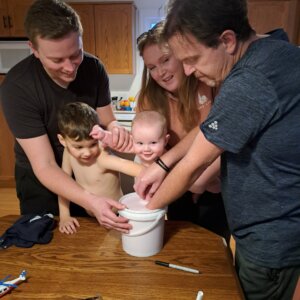 From Jan. 1 to April 8, 2025, the McGoverns made the most of their time.
They spent 100 days together at home. Their days were quiet and intentional. There were shared meals, long conversations and hours spent sitting side by side. John’s energy was limited, and Tali protected it carefully.
“I put a sign on our door that read, ‘If you haven’t made arrangements with Tali, don’t knock,’” she says, “because it was taking my time away from John.”
Visits were planned with care, and boundaries were set so Tali could focus on being a wife, rather than a host.
During that time, John continued to create.
He kept up with his podcast, Sunshine Peering Through the Fog, which he started to document his journey with PTSD. At this point, Tali had to help him log in, which she says was difficult as he was always the tech-savvy one.
He also picked up where he’d left off on a children’s book he’d started, called If You Wore a Cape, What Colour Would It Be? The book celebrates everyday heroes and reflects John’s belief in kindness and service.
“When the book was published, he cried and cried,” Tali says. “We decided that part of the proceeds would go to charities of John’s choice.”
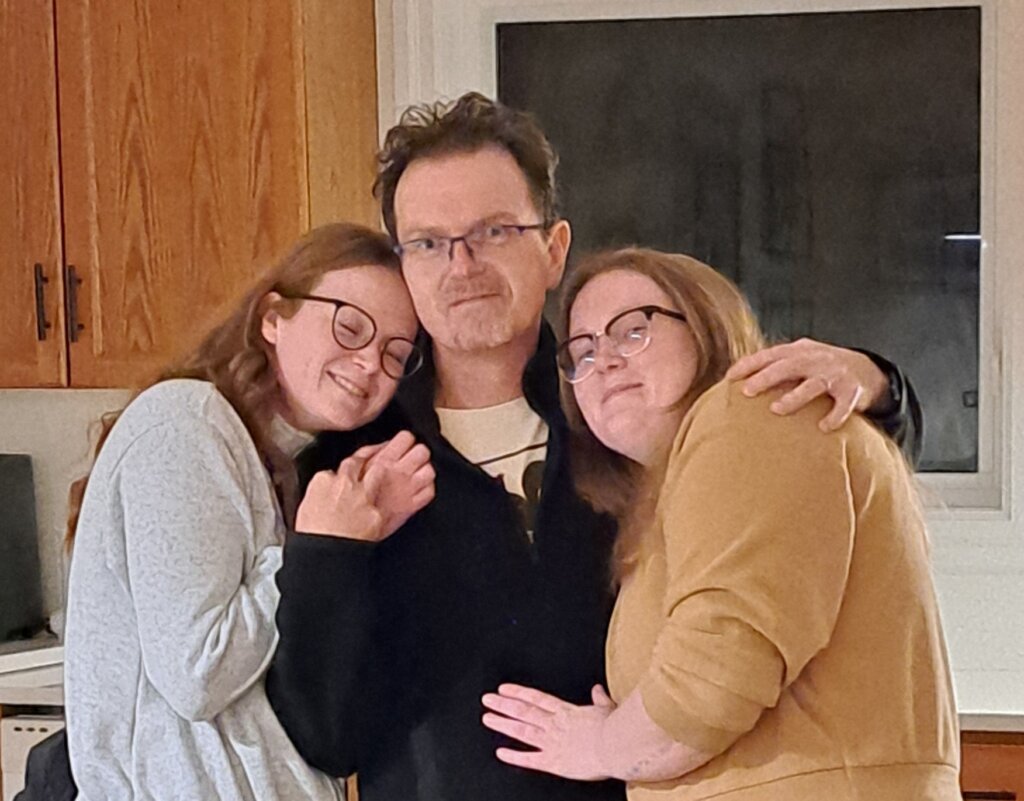
There were also small, meaningful acts of remembrance. Hug shirts were created with painted handprints and embraces. Stories were recorded for his daughters. These moments became tangible ways to preserve his presence and voice.
When John decided it was time for him to go, they had a family phone call with someone who explained the Medical Assistance in Dying (MAID) process.
“He was just like, ‘She’s ruthless, hey?’” Tali says, of John’s joking nature. “I’m glad he said it, because the rest of us were thinking it. I’m sure she had to remind him of the process and to be sure he was okay with it, but it made us laugh in the moment.”
Then came having to make further decisions.
“We had to choose a date,” Tali says. “My oldest daughter asked what worked for me. And I’m like, ‘This is not like booking a hair appointment, people.’”
She recounts it with the same humour that’s carried her through from day one—the humour that John knew and loved.
In the days leading up to John’s passing, the family spent quality time together, talking and taking a family walk. Tali remembers watching John’s favourite movie, Grumpy Old Men, with him, and laying out the honour guard uniform John wanted to wear in his last moments.
“I know my husband made the decision because he wanted to go out with dignity,” Tali says. “He was selfless and didn’t want us to see what was going to come. He looked out for us until the very end.”
After John passed, Tali had a hard time living under the same roof that reminded her of such a significant loss.
“Back in 2024, when we moved, he wasn’t laughing and he wasn’t smiling and he wasn’t down for adventures,” Tali says. “I 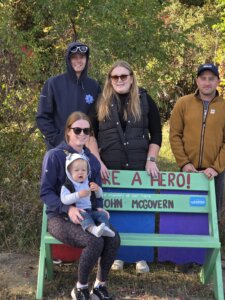 decorated the entire house with pictures of every adventure we went on—Jamaica, Greece, Ireland, the Dominican Republic, Cuba, Florida—I can’t visualize taking them off the walls and replacing them with something else in this house.”
She’s making a fresh start in a condo she once looked at with John, while carrying the memories of their near-30 years together with her.
“I still celebrated our 30-year anniversary in 2025, even though he wasn’t with me,” Tali says.
She’s also been documenting her journey and sharing on the podcast John started, while continuing to donate proceeds from his book to causes that meant something to him. Recently, she contributed $1,000 to Brain Tumour Foundation of Canada in his memory.
“It’s been a life lesson,” Tali says of her experience, “and I’m glad I got to go through it with John.”