Learning to move forward
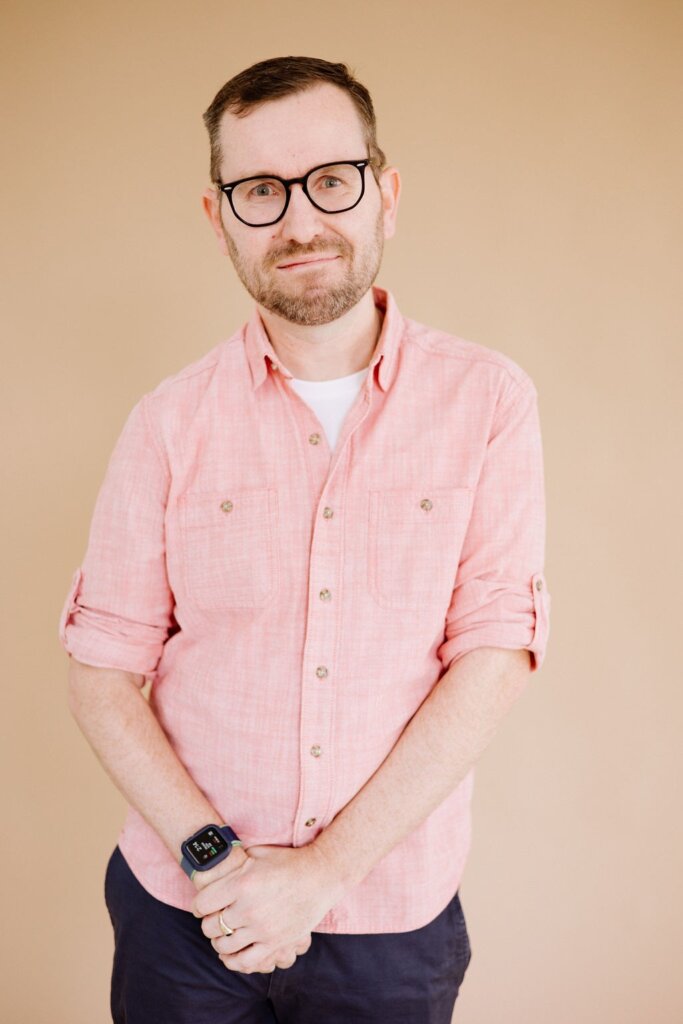
At 25 years old, in 2008, Justin Doyle was looking ahead to the next phase of his life.
Living in Cambridge, Ont., he’d been going to school to become a child and youth worker. As part of his program, he rotated between an academic semester and a work placement so he could gain the skills and hands-on experience he needed for his new career path.
It was partway through his studies that he experienced a grand mal seizure, which came without warning signs.
He was rushed to the hospital, where a CT scan revealed something concerning. There, he was told there was a six- to eight-month wait for an MRI.
That didn’t sit well with his family. Determined to get answers, his dad pushed back.
“He basically said, ‘I’ll drive him across the border if I have to,’” Justin recalls. “That got things moving pretty quickly.”
Searching for answers
Within 48 hours, Justin had the MRI he needed. The scan revealed a mass deep in the left thalamic region of his brain.
He was sent to Hamilton, Ont., for evaluation. Doctors thought he might have neurocysticercosis, a parasitic infection of the central nervous system that can cause seizures, headaches and confusion.
Justin was later transferred to Princess Margaret Cancer Centre in Toronto, where specialists confirmed he had a low-grade ganglioglioma.
“It was benign, which was lucky,” Justin says. “But because of the location, they had to take a slow approach.”
For a year, Justin continued living with a brain tumour and not experiencing symptoms.
“I felt fine, for the most part,” he says. “Other than taking medication after the seizure, nothing really changed day to day.”
In 2009, Justin underwent six weeks of radiation therapy. Even then, he kept going.
“That summer, I was doing radiation during the week and working weekends in a group home,” he says. “It was something I could control.”
Addressing the unavoidable
His tumour continued to progress.
By 2010, a cyst had developed and was growing into the corpus callosum, the structure connecting the two halves of the brain. At that point, surgery became unavoidable.
“The doctors said they didn’t know what it would look like in six months if they didn’t operate,” Justin says. “Their hands were forced.”
The surgery was risky, given the tumour’s location, and left Justin with lasting effects. He spent a month in inpatient rehabilitation, relearning how to move and adapt.
Much of his recovery took place alongside stroke patients, as the physical impacts were similar. However, there was one key difference.
“With stroke patients, the brain can often rewire itself,” Justin says. “Because of where my tumour is, mine can’t.”
He now walks with a brace and has limited mobility on his right side.
“I was right-handed,” he says. “Now I do everything with my left. It’s definitely been an adjustment.”
Keeping things “as normal as possible”
He’d finished his academic semester six weeks early so he could have surgery and returned just one month later to complete his final placement.
“The placement was 40 hours a week in a treatment facility,” he says. “I wanted to keep things as normal as possible.”
That mindset carried through the years that followed.
Justin went on to earn a degree in history at the University of Waterloo with plans to become a teacher. But along the way, something shifted.
“I realized there wasn’t enough focus on students’ mental health,” he says. “We focus so much on academics, but not enough on how people are actually doing.”
That realization, shaped in part by his own experience, led him in a new direction.
Justin returned to school, earning both a bachelor’s and a master’s degree in social work. Today, he works as a social worker, supporting others through their own challenges.
A new challenge
More recently, it was discovered that the tumour has grown again, and Justin is now undergoing targeted therapy.
“It’s a daily medication,” he says. “We’re trying to manage it without surgery.”
The treatment hasn’t been easy. At first, the side effects were severe.
“I broke out so badly it was almost unbelievable,” he says with a laugh. “It was around Halloween, and I didn’t even need a costume.”
Since adjusting the dosage, things have improved.
“You can only control what you can control. If you focus on everything else, it just consumes you.”
Through every stage, from diagnosis, to treatment, to recovery, and progression, Justin has held onto that perspective.
He leans on the people around him when needed but keeps his focus on moving forward.
“Try to keep doing the things you were doing before,” he says. “The moment you start thinking, ‘I can’t do this’ or ‘this is too hard,’ that’s when things get tougher.”
His advice to others facing a similar diagnosis is simple yet powerful.
“Focus on what you can control. Rely on your support system. And in the end, you’ve got this.”