Life beyond a brain tumour
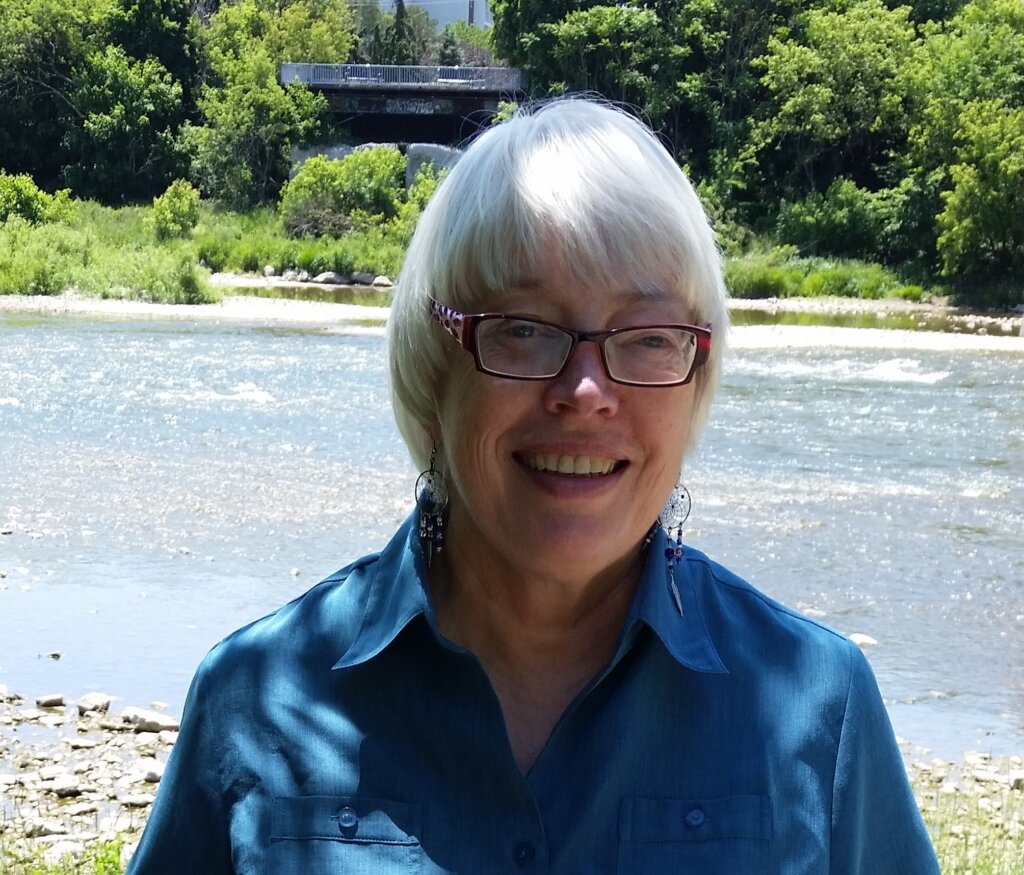
Barb Wentworth never expected a brain tumour would become the turning point of her life. In 1988, when she was 38 years old, she was supposed to be preparing for a cross-country bicycle trip that she and her former husband were organizing. Twenty-five riders signed up, with Barb’s daughter, Sara, 11, set to ride behind her on a tandem, her son, Mark, 15—who lived with cerebral palsy and a developmental disability—in summer respite care, and her son, Jason, 18, with family.
She’d recently returned to her hometown of Toronto, Ont., from Vancouver, B.C., where she was a special education teacher.
Having worked with children who had additional needs all day and then returning to her own children—particularly Mark, who also had additional needs, Barb felt overloaded and decided to take a break from work.
Feeling more tired than usual
She was eager for her upcoming bike trip, as biking was a passion of hers, though training for the ride was a struggle.
“I was dragged out and tired,” Barb says.
She saw her family doctor, who suggested a physical exam and an eye test.
“I covered my right eye and it looked how it would if the shower steamed up the mirror in your bathroom, and you tried to clear it with your fingers,” Barb says. “I didn’t see it when I had both eyes open, only when I had one covered.”
She was referred to an ophthalmologist, who thought Barb’s vision trouble could be caused by optic neuritis—a condition that happens when the body’s immune system, in response to the flu, mistakenly attacks the optic nerve.
A change in plans
After a CT scan and an MRI, Barb learned she had a meningioma tumour in her optic chiasm. Within a week, she was in surgery, in the hands of late neurosurgeon Dr. Fred Gentili.
Barb’s husband started the cross-Canada bike trip in B.C., though she asked him to return when her recovery proved too difficult to manage on her own.
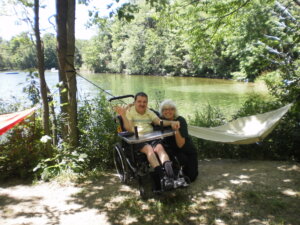 “It was a loss of a big dream for all of us,” she says.
Even more devastating was that Mark, who Barb and her family took in as their own child but who was still legally in foster care, was placed in a group home while Barb was in the hospital.
“We didn’t place him and we didn’t have a choice in the matter,” Barb says. “We were just lucky he was placed in Toronto and not somewhere else, because how could you ever deal with that?”
That period of time was a blur, and not one that Barb recalls fondly.
“I don’t even remember who packed up Mark’s things,” Barb says. “He had a bedroom at home and then all of a sudden, he was gone. I don’t know how he made any sense of it.”
Barb brought Mark home on weekends once she was feeling up to it, but she couldn’t care for him full-time given her own health challenges.
“I changed from being a hands-on caretaker mom to being a mom-advocate for my son in his group home,” Barb says. “Both roles were equally challenging. During that time, my daughter missed the cross-Canada adventure, spent the summer learning to play classical guitar and was my greatest supporter. My oldest son suffered from our lack of communication and support. Lots of feelings of abandonment, anger and sadness for everyone. I wish it hadn’t been so.”
Choosing her own path
Barb returned to work after her first surgery, taking a position as a bicycle safety planner for the City of Toronto.
She was still managing her symptoms through this time and checking in with Dr. Gentili, who became a lifeline for her, quite literally.
Three years after her first surgery, she recalls a phone call she received following an MRI.
“Dr. Gentili told me I needed to come in right away to have surgery again,” Barb says. “The tumour was eating away at my left optic nerve. I said ‘no,’ which I’m sure surprised him.”
Barb’s husband had qualified for the Paris-Brest-Paris (PBP) 1,200-kilometre randonneuring bicycle ride (an endurance ride that covers pre-planned routes with a time limit) and they had plans to leave for Paris in a few days.
“I couldn’t ask him to give up that dream, again, due to my brain tumour,” Barb says. “I had the surgery when I got back home. I lost all vision in my left eye.”
Another four years later, Barb was dealing with difficulties on all fronts. She was going through a divorce, dealing with increasing headaches, pressure and stress, and her MRI showed tumour growth.
“Dr. Gentili said he wouldn’t recommend surgery because I wasn’t having any functional loss,” Barb says. “I told him I’d think about it. Then, I phoned him back and said I wanted to go ahead with the surgery, even knowing the risks involved. Without giving me a hassle, he went ahead with the surgery and again, removed a large part of the tumour.”
Barb attributes this surgery to the long ‘wait and see’ period, before she chose to have radiation in 2014. She’d hoped the radiation would relieve the pressure of the growing tumour behind her left eye.
“Dr. Gentili was amazing in allowing me to make decisions that worked for me and my life, even if he didn’t necessarily agree with me,” Barb says.
Barb relied on her Unitarian church community at this time, with members of the congregation driving her to and from her radiation treatments.
“It was actually kind of wonderful, in a way,” Barb says.
Moving forward through loss and grief
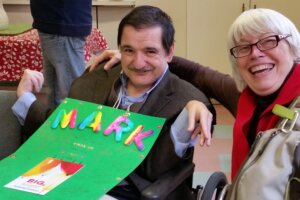 While on her own health journey, Barb helped Mark through his diagnosis of Rett syndrome at age 40.
“It totally made sense once we got the correct diagnosis,” Barb says, of the rare, genetic neurological and developmental disorder that shaped the way Mark’s brain developed and influenced so much of his life. Mark, sadly, passed away at age 44 in 2017.
Dr. Gentili, another deeply significant figure in Barb’s life, also tragically passed away only a few years later, having been diagnosed with glioblastoma. (Read Dr. Gentili’s story here.)
It’s important to Barb to honour those who changed her life so profoundly, sharing her gratitude for Dr. Gentili’s kind and compassionate care and writing about her experience with her son Mark’s challenges.
She’s put together a story she’d like to share with other families that have a loved one affected by a disability, as well as health-care professionals. The Story of Mark and Me is a four-part, 40-minute presentation that Barb likens to a TED talk, with audio and visual elements.
“It’s been an interesting project,” she says. “I’m learning new things about myself and my life by doing this writing. I hope this to be a legacy for Mark.”
Finding the positives
Meanwhile, Barb has been spending time at a Unitarian camp north of Toronto, just this year upgrading from a tent to a bunkie.
“It’s fabulous to be within a good community and to be able to get out into the woods,” she says.
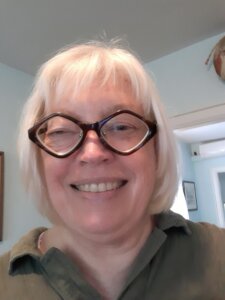 She’s learned to live without vision in her left eye, even finding a positive—and humorous—take on it.
“I have no light coming in that eye at all, which is great because when I tuck my head on the pillow, I can make it nighttime and go to sleep anywhere,” she says, laughing.
As Barb writes in The Story of Mark and Me, “People sometimes imagine that a brain tumour becomes the centre of your story. But for me, living with one has always been something I deal with around the rest of my life—not instead of it. My life has always been more interesting than my tumour.”
She continues to find joy in the small things, staying connected to her community and nature.
“I pay attention to my brain tumour symptoms when I need to,” she says, “otherwise, I get on with living a pretty incredible life.”