Finding strength in uncertainty
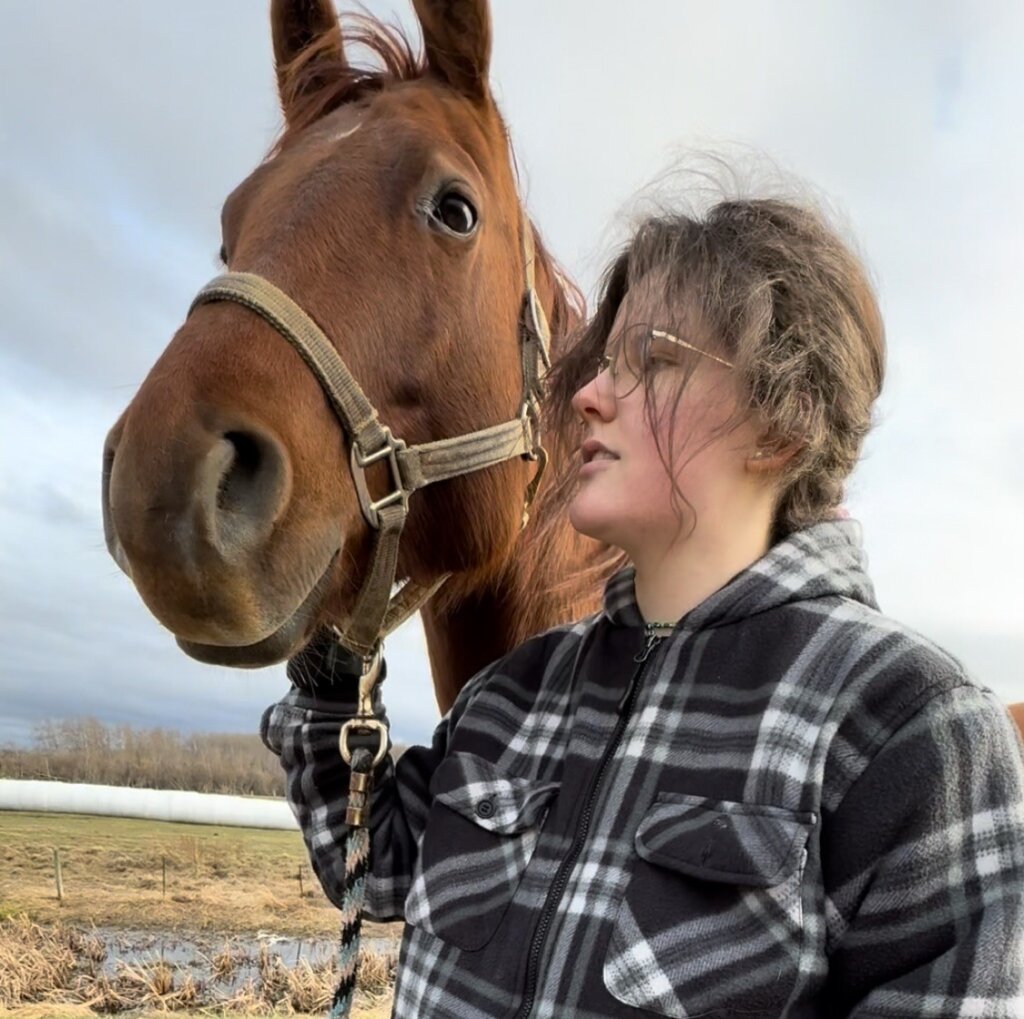
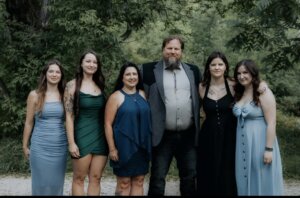
In 2024, Emma Garlinski had just turned 20 and was living in Grandview, Man., a small community of about 1,400 people.
She’d been working in hospital security, spending her downtime with her boyfriend and friends, and helping out at her family’s farm. She’d also been having migraines, which would come and go, until eventually, they wouldn’t subside.
“I was popping Advil every four hours and it wasn’t doing anything,” Emma says. “Then, my face started to go numb.”
She went to the doctor, hoping for answers. Instead, she was brushed off and told to come back if her symptoms worsened.
She saw another doctor a month later, who didn’t take her seriously, either.
“He was kind of like, ‘You’re young, you’re healthy, there should be no reason this is happening,’” Emma says. “He didn’t even send me for bloodwork or anything.”
Searching for answers
The numbness kept spreading, down her face and into her mouth.
The next day, Emma drove herself to the emergency room in Dauphin, Man., and waited more than 10 hours to be seen. This time, someone listened.
“The doctor said, ‘Your face going numb isn’t a good thing,’” she recalls. “So, he ordered a CT.”
The following morning, she got a call to come back and bring a support person.
“I asked, ‘A support person as in a driver, or an emotional support person?’” Emma says with a small laugh. “And they were like, ‘I really don’t know.’”
The appointment that changed everything
Doctors discovered a tumour extending through Emma’s face and into the frontal lobe of her brain.
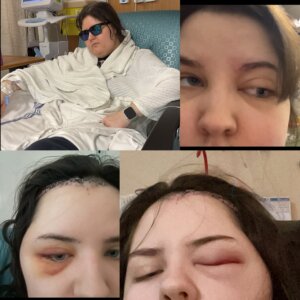
Within weeks, she lost vision in one eye and was sent to Health Sciences Centre in Winnipeg for emergency surgery.
What was supposed to be an eight-hour operation stretched to nearly 13 hours, given unexpected complications. Emma required a bone replacement during surgery, also experiencing a brain bleed.
“I almost died,” Emma says. “They had to give me two bags of blood.”
Even after surgery, doctors still didn’t fully understand what they were dealing with. The tumour looked like a rare type of meningioma, but it behaved aggressively and carried unusual genetic mutations. Specialists in Winnipeg sent tissue samples to Toronto for further analysis.
 “They said they weren’t really doing diagnostic testing anymore,” Emma says. “They were doing more research-based testing trying to figure out what it was.”
Then came 30 rounds of radiation.
Emma spent weeks living in an Airbnb in Winnipeg, away from home, enduring pain that became almost impossible to describe.
“I woke up one night with excruciating knee pain, which was weird because I’ve never had knee problems before,” she says. “It felt like someone was hammering knives into my knees. But the brain, the body—it’s all connected. People don’t talk about how it affects your whole body.”
Her pain persisted, spreading across half her face.
“It was like someone holding a blowtorch in my mouth and pushing a hot brick against my face,” she says. “I was sucking on ice constantly just to dull it down a little bit.”
The pain, which she later learned was consistent with trigeminal neuralgia, became a constant part of daily life.
Coping with the unexpected
Emma was prescribed steroids, which helped her pain immensely but led to a 60-pound weight gain. The swelling changed her appearance so dramatically that some people no longer recognized her.
“That actually hurt a lot more than you think it would,” she says.
It also impacted her vision, which had returned post-surgery.
“I went blind again,” she says. “I just figured, maybe when the swelling goes down, it’ll come back.”
Emma was left with stretch marks and skin damage so severe that she required home care.
“I was covered in open wounds,” she says. “Everything they tried to put on me, I reacted to.”
While the steroids initially helped her pain, the side effects eventually began doing more harm than good. Despite the severity of her symptoms, she struggled to find effective long-term pain management.
The tumour continued to grow unpredictably. Discussions shifted toward palliative care. Emma remembers being handed paperwork asking about her final wishes.
“They were basically saying, ‘If this doesn’t work, there’s nothing we can do,’” she says.
But her family refused to stop searching for options.
Her parents gathered medical records and sent them to the Mayo Clinic. Her sisters organized a community fundraiser in Grandview with raffles, burgers from the family farm and tables packed into the town hall.
“It meant a lot to me because I worked a couple different jobs around town,” Emma says. “There were people I went to school with, seniors I’d worked with—people showed up.”
Today, Emma is on her eighth round of oral chemotherapy while doctors in Canada and at the Mayo Clinic continue to monitor her rare tumour.
A recent scan showed what doctors suspect may be growth, which means another surgery. Specialists at the Mayo Clinic plan to remove as much of the tumour as possible through an endoscopic procedure, followed by proton radiation therapy.
A more extensive resection remains an option if needed, but because the tumour is currently sitting on a carotid artery, the procedure carries significant risks.
“They don’t even know whether to call it cancer or tumour,” Emma says. “The Mayo Clinic isn’t sure if all of it is growth or if some of it is necrosis.”
Emma says she has been feeling sicker and experiencing more pain, signs that something is changing even if doctors don’t yet have all the answers.
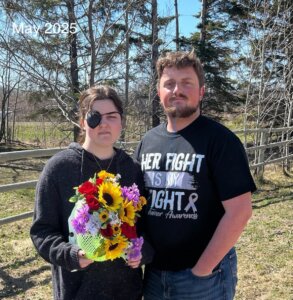 She is permanently blind in one eye and still lives with chronic pain, fatigue and neurological symptoms that affect nearly every part of her life.
“There’s a lot of things that have been stripped away,” she says. “I can’t go to movie theatres anymore. Loud events are hard. I’m much more sensitive to sunlight.”
There have also been educational and career opportunities she feels have been taken from her while she focuses on treatment and recovery.
Now, as she waits for a surgery date, she remains optimistic about the future.
About moving out with her boyfriend someday. About living a long, happy life. About motivating others to keep going.
“Sharing my story, I hope it makes someone realize that they can handle today,” Emma says. “That’s the way I think. I woke up this morning. I was meant to wake up this morning. So were you.”