Growing through the discomfort
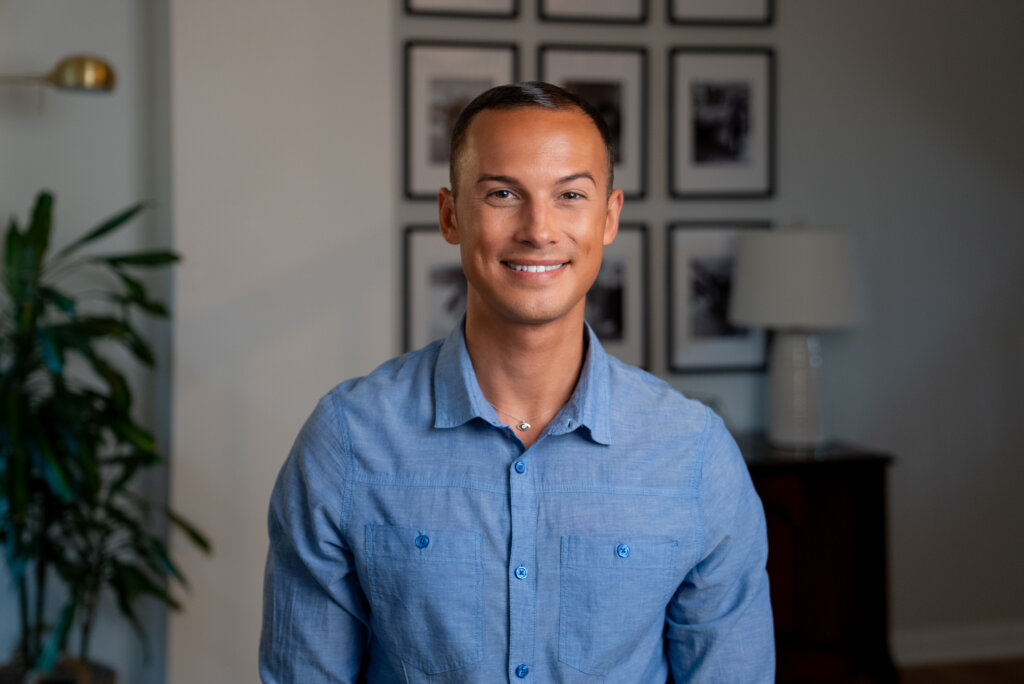
Throughout Brendan Yhip’s life, he’s had to learn and adapt to unexpected circumstances. Then, he’s had to learn and adapt again.
Now 31, Brendan was diagnosed with a brain tumour at age 12, after a sudden seizure.
His tumour, a low-grade pleomorphic xanthoastrocytoma (PXA), was found in the hippocampus of his brain, causing seizures and affecting his short-term memory. As his tumour was thought to be slow-growing, doctors gave Brendan the option to continue to monitor his tumour or have surgery.
“At such a young age, you’re thinking about going into Grade 7 and what shoes you’re going to wear on your first day,” Brendan says. “At the same time, I recognized there was a magnitude to my diagnosis. I made a pact to live life like I didn’t have a tumour, because I was told it wasn’t something to worry about.”
 Living life with a tumour
Brendan was an outpatient at Toronto’s SickKids until he reached adulthood, later being monitored by Toronto Western Hospital.
With his tumour stable, he was able to live independently in Toronto and pursue a career in marketing and fashion. He worked with local fashion and bridal designers, eventually running a bridal store and preparing to release his own bridal collection.
Challenging himself further, Brendan also took a job teaching in the Longo Faculty of Business at Humber Polytechnic.
“I can look back on it now and think, ‘How did I do that?’” he says. “There was a lot of mental chaos because I was juggling so much and adapting to this next phase in my health-care journey. But I did it.”
Brendan’s surgery
Two weeks into his first semester of teaching, Brendan learned his tumour had grown and he could no longer put off his surgery. The possible side effects, from losing vision in his left eye to losing his speech, were hard to accept.
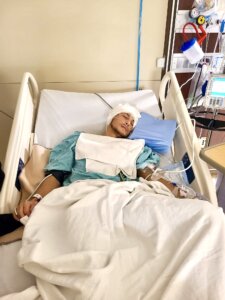 The night before his craniotomy, Brendan recalls grading papers and struggling to come to terms with the “what ifs.”
“It was a lot to digest,” he says. “I prepared for the worst, if I’m going to be morbidly honest with you.”
Brendan’s surgery, which took place at University Health Network’s (UHN) Krembil Brain Institute in December 2022, was a success. Doctors were able to remove his tumour, warning that it could have become malignant.
“Going in, they thought my tumour was the size of a pea,” Brendon recalls. “It actually went from the back of my brain to right behind my eyes. It was pretty astonishing.”
Finding support with an ‘invisible injury’
Brendan did experience partial vision loss and cognitive impairment that affected his speech.
“It’s difficult when you have an invisible injury,” Brendan says. “I look healthy, but lo and behold, I was struggling to get the communication from my brain to my mouth. Everybody was like, ‘You fine?’ And I thought, ‘No, I’m not fine. I need rehab.’ Thankfully, rehab got me where I am today.”
Brendan focused on speech pathology and cognitive therapy, while also working with a social worker, in his time at UHN’s Toronto Rehab. All the while, he gave himself grace to recover, as he adjusted to life now.
“I’m rebuilding my foundation,” he says. “It’s not as simple to just get back to normal when you have deficits and you’re existing in a new way. I’m discovering new interests. I’ve lost relationships and I’ve built new relationships. I’m learning more about myself and finding new ways to enjoy life.”
Recovering his own way
Brendan dove into fitness, going for his first run three weeks post-surgery.
“It wasn’t to have ‘the body,’” Brendan says. “It wasn’t anything of that nature for me. It was more so to be able to move again—to have the power to do that with my body.”
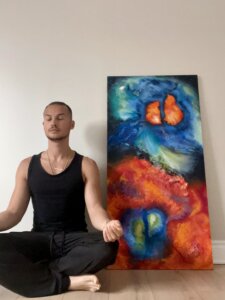 He started meditating, a practice he continues every day. Journalling was another activity that helped him navigate this new way of life.
“It was about letting things out in a healthy way,” Brendan recalls.
One way he did that, which he says he didn’t realize he was doing at the time, was to lean into his childlike side.
“It was going on a swing set,” he says. “I can’t tell you how many times I sat and cried on a swing because it made me so happy. I would sit in a tree and feel like I was living in a movie. I would walk down the street and listen to music that fuelled my soul. And when you listen to a song over and over again, the words start to stick. It helped me with my speech and my memory, but music also brought me joy.”
Brendan describes feeling more emotional than usual during his recovery and embracing it.
“I learned that when your brain is recovering, it does impact your emotions across the board,” he says. “When I was really upset or angry or frustrated, I felt it and I got through it, rather than banking it and allowing it to impact me later in life. For me, that anchored my recovery process.”
Brendan, who has a bachelor’s degree in fine arts, also expressed himself through collaging and drawing. He describes a mural he drew on his bedroom wall, etching a design whenever the mood would strike.
“There was a lot of self-reflection,” Brendan says. “I worked on being present, which ties in with memory and cognition, but also spirituality. It made me appreciate the whole process.”
Gratitude and giving back
Along with the effort he devoted to healing, Brendan credits the people who stood by him through his hardest moments.
“I have a really lovely family and close friends who were there for me,” Brendan says. “I’m blessed to have that kind of support and love, because I know not every patient has that.”
His care team was also instrumental in not only his physical recovery, but his mental recovery, too.
“My psychologist in rehab pointed out that I’ve been through three different traumas,” Brendan says. “There was the trauma leading up to my surgery, then having the surgery, and then recovering from it. I would say the buildup leading up to my surgery was the most uncomfortable, followed by the recovery.”
“I understand that when it’s uncomfortable, that means it’s growth.”
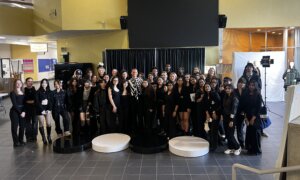 Brendan is back to teaching at Humber Polytechnic, working in both the Longo Faculty of Business and the Faculty of Media, Creative Arts, and Design.
Giving back is important to Brendan, too, which is why he became a patient partner with the University Health Network (UHN) that made a difference in his journey. In this volunteer role, he earned the 2024 President’s Patient Partner Award for his contributions to Project Aspire: The Development of the Toronto Western Tower.
He’s since taken on a new role with UHN as a patient ambassador, supporting patients through their care journeys.
In addition, he remains actively involved in the fashion industry, recently taking part in Toronto’s Fashion Week.
“Life is picking itself back up,” he says.
Choosing positivity
He’s been told his tumour could come back with a “vengeance,” but thankfully, his one-year scans have not shown regrowth.
“We can’t worry about the unknown. We can only be in the present.”
Brendan has worked hard to achieve his outlook, saying positivity is a choice he made.
“Going through something like this really does change your perspective,” he says. “There was so much unknown and I kind of surrendered to it.”
“Some of the ugliest parts of this are some of the most beautiful things that I think back to,” he continues. “I’m so grateful to have learned some of life’s greatest lessons on this journey. This experience brought me to life.”