
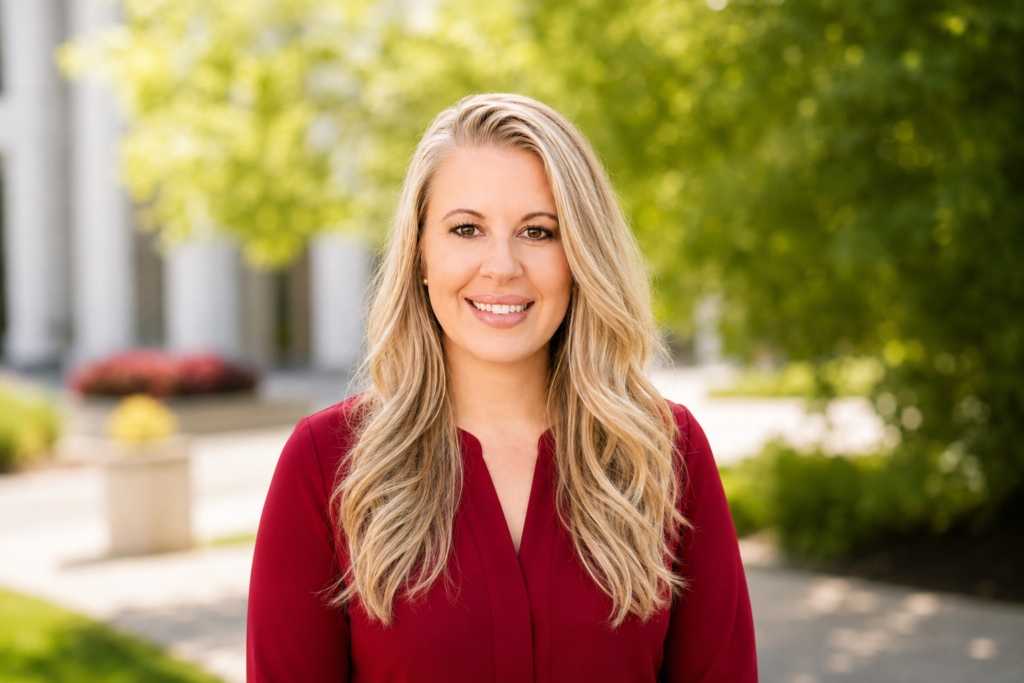
Redefining what’s possible: Kyla’s story
For years, Dr. Kyla Tozer lived with debilitating headaches that seemed to have no explanation.
Beginning in her early teens, she experienced increasingly severe migraines, often visiting her family doctor in search of relief. By her early twenties, the pain had become a constant part of her life.
In 2009, after years of worsening symptoms, Kyla finally requested an MRI. What followed was a brain tumour diagnosis that would change the course of her life in ways she never could have imagined.
More than 15 years later, Kyla has earned her PhD and is conducting postdoctoral research at Sunnybrook. But her journey from patient to researcher has been shaped by more than academic achievements. It’s a story of perseverance, adaptation and learning that a brain tumour diagnosis doesn’t have to define what’s possible.
Years of unanswered questions
Kyla was just 12 or 13 years old when she began experiencing severe migraines. Over the years, the headaches grew progressively worse, despite repeated visits to her family doctor.
She remembers feeling intense pressure behind her eye, with pain that could be temporarily relieved by pressing against it, only to return immediately afterward.
By her early twenties, she knew something wasn’t right.
“This just doesn’t seem right that people would be in this much pain all the time,” she recalls thinking.
After years of living with the symptoms, Kyla asked her doctor for an MRI. She remembers his response vividly.
“What, do you think you have a brain tumour?” he asked.
“I don’t know, but this just doesn’t seem right,” Kyla replied.
Within 24 hours of the scan, she received a call asking her to return to her doctor’s office. The MRI had revealed a brain tumour.
Kyla was initially told the tumour was approximately the size of a cherry tomato and was referred to a neurosurgeon for further assessment. When she met with the specialist, however, she learned the tumour was considerably larger than she had been led to believe.
“That has to come out. That’s about the size of a softball,” she recalls him telling her.
Despite the seriousness of the situation, the neurosurgeon’s straightforward approach and sense of humour immediately put her at ease.
“I feel safe with you because you’re not just going to tell me what I want to hear,” she remembers thinking.
For the first time in years, Kyla felt confident that someone understood what she was experiencing and knew how to help.
A life-changing surgery
In 2009, Kyla underwent an eight-hour operation to remove a meningioma located in the prefrontal region of her brain.
Surgeons were able to remove most of the tumour, although some tissue remained near her optic nerve and carotid artery.
When Kyla woke up in the recovery room, she immediately noticed something remarkable. For the first time in years, she was no longer experiencing the debilitating pain that had become part of her everyday life.
“I can see the clock,” she remembers telling her surgeon as she looked across the recovery room.
The relief was overwhelming.
“I was so overwhelmed with joy that I was no longer in pain anymore,” she says.
Her neurosurgeon continued to follow her recovery for the next decade, regularly monitoring the remaining tumour tissue for signs of growth. The relationship transformed the way Kyla viewed the medical profession.
“He totally changed how I felt about physicians,” she says.
While some tumour tissue remains on her optic nerve, Kyla says it has remained stable. She continues to undergo visual assessments to monitor for any changes affecting her left eye.
After years of routine MRI surveillance, Kyla is now transitioning to ongoing eye care, with additional imaging if concerns arise. It’s a reassuring step forward after so many years of monitoring.
A new direction
Before her diagnosis, Kyla had been working in retail management. She had no post-secondary education, but her experience with her neurosurgeon had sparked an interest in medicine and neuroscience.
She began to imagine a future she hadn’t previously considered possible.
When she shared her dream of becoming a doctor, however, she wasn’t always met with encouragement.
“Anytime I ever told anyone I wanted to be a doctor, they would laugh at me,” she recalls.
By her mid-twenties, Kyla was also raising a young daughter and questioned whether returning to school was realistic. But the encouragement of people who believed in her helped change her perspective.
“They just gave me that right push I needed to not question my abilities,” she says.
Kyla enrolled at Queen’s University, where she completed her undergraduate degree and became involved in neuroscience research related to neurosurgical interventions. Her academic interests eventually led her toward infectious diseases.
She went on to complete her PhD and began working as a postdoctoral researcher at Sunnybrook.
While her academic accomplishments marked an exciting new chapter, returning to school also meant learning to navigate the lasting effects of her brain tumour.
Learning to adapt
Although Kyla experienced tremendous relief following surgery, her recovery wasn’t without challenges.
As she pursued her education, she began to recognize that her brain injury had left her with lasting cognitive difficulties. Through a neuropsychological assessment, she learned more about how her brain processed information and discovered strategies to help her approach learning differently.
“When I went back to school, I didn’t realize that I had lifelong deficits that couldn’t be fixed, but I could learn how to work with them,” she explains.
The realization changed the way she approached both her education and her abilities.
“As hard as it was, you can learn different paths to do the same thing,” she says.
It’s a perspective she now shares with others facing similar challenges.
“Yes, you may have a disability,” she says, “but there are other ways to learn it.”
Her experience has also shaped her understanding of the emotional impact of a brain tumour diagnosis.
As a young mother, Kyla lost many of the early memories of her daughter’s life. She remembers little from before her daughter turned two and believes some of the memories she does have may come from photographs rather than firsthand recollections.
While those lost memories have been difficult, her daughter has remained a constant source of strength and motivation.
“She’s been my rock getting me through it,” Kyla says. “As much as I’ve inspired her, she’s been my major motivation to do everything I’ve done.”
Turning experience into action
Kyla’s personal experience has inspired a lasting commitment to supporting others affected by brain tumours and neurological conditions.
During her undergraduate studies, she helped organize a series of fundraising races benefiting the Department of Neurosurgery. From 2017 to 2020, the initiative offered distances ranging from one kilometre to a half-marathon and raised nearly $100,000.
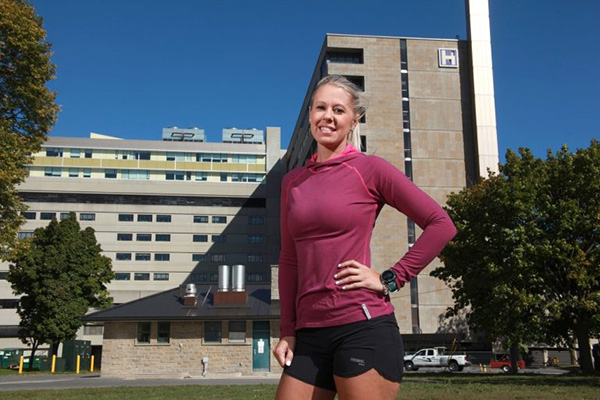
The events also provided opportunities for people affected by brain injuries to learn about recovery, rehabilitation and available supports through educational sessions with medical professionals.Sharing knowledge and bringing people together has since become an important part of Kyla’s efforts to give back.In 2026, she became a Community Champion for Brain Tumour Foundation of Canada’s Brain Tumour Walk, an opportunity to connect with a community that understands the challenges of living with a brain tumour.
Having spent years connecting with other survivors, Kyla knows how meaningful those relationships can be.
“You can explain it to so many people, but only true survivors get it,” she says.
She believes simply being surrounded by people with shared experiences can make a tremendous difference.
“Sometimes it’s just so nice to be around those people where you don’t have to try and explain things,” Kyla says. “Everybody just knows.”
While fundraising and awareness are important, the sense of belonging is equally valuable.
“Having that opportunity to be around people and share that experience is worth everything,” she says.
More than a diagnosis
Drawing on her own experiences, Kyla is working to challenge misconceptions about brain tumours and the lasting effects of brain injuries.
She knows that discussing those challenges can be difficult, particularly when people make assumptions about what someone living with a disability can or cannot accomplish.
“Talking about having brain injuries and brain tumours comes with its own set of stigmas,” she says.
Sharing personal experiences, however, can be a powerful way to challenge those perceptions.
“That doesn’t have to be our identity,” Kyla says.
By speaking openly about her journey, she hopes to help others feel more comfortable doing the same.
“Sometimes just talking about it and being a face for it is enough to start breaking those boxes down,” she explains.
Kyla hopes that sharing her experiences will help others affected by brain tumours recognize that they aren’t alone and that their lives can continue to hold opportunity, purpose and achievement, even when the path forward looks different than they expected.
From a young woman seeking answers for years of unexplained pain to a researcher helping advance scientific knowledge, Kyla’s journey has taken her places she once struggled to imagine.
And through it all, she’s learned that while a brain tumour may change the course of someone’s life, it doesn’t have to determine how their story unfolds.